
AI-generated prose can hide weak evidence behind smooth language. The answer is a small, repeatable claim audit. This tutorial uses ChatGPT to expose what needs checking, then uses original sources and your own judgement to decide what can remain in the article.
Checked: 10 November 2026. Features and menu labels can vary by plan, workspace and rollout.
Before you start
A draft article, access to its sources and web search where available. Remove any material you are not authorised to share. Work on a copy so the original wording and the record of corrections remain available.
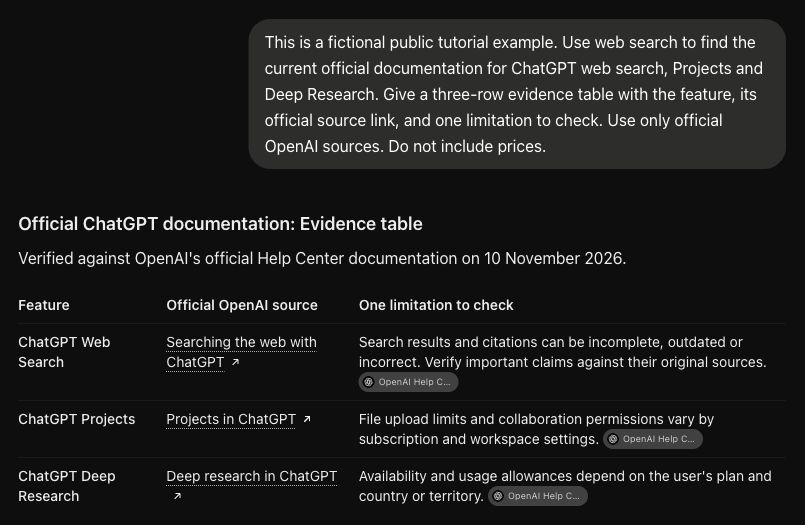
1. Extract checkable claims
Ask for a table of factual statements, keeping each one separate. Include product capabilities, dates, account requirements, prices and attributed quotations. Do not ask the model to judge the whole article as “true” or “false”; broad confidence scores are difficult to audit.
2. Prioritise by consequence
Check the claims that affect a reader’s decision or ability to complete the tutorial first. A wrong export limit, menu path or model requirement can make an otherwise useful guide fail. Low-impact descriptive language can wait until these operational details are settled.
3. Find the closest original source
Use official documentation, release notes, primary research or the original announcement as appropriate. A search snippet is a lead, not the final evidence. Ask for a direct link to the relevant page rather than a general homepage that only mentions the product.
4. Read the evidence yourself
Open the page and compare its wording with the draft. Does the feature apply to this plan and platform? Is the information current? A sentence can be broadly plausible while combining details from different product versions. Mark unsupported details as unresolved.
5. Revise with a visible record
Keep the original claim, verdict, source and replacement wording in the table. Delete unnecessary claims that cannot be established. When a useful fact remains uncertain, write the uncertainty plainly rather than replacing it with a new confident guess.
6. Test the instructions
For a step-by-step guide, follow the important path in the current interface where possible. Use fictional data and a reversible example. If you checked documentation but did not run the workflow, say so. Revisit fast-changing details before publication and record a meaningful checked date.
A prompt to adapt
Audit this draft without rewriting it yet. Extract material factual claims into a table: exact claim, why it matters, best primary source, evidence status and proposed correction. Use web search for changeable facts. Distinguish confirmed, contradicted and not verified. Do not invent citations, quotations, test results or confidence percentages. Flag account and platform differences.
Check the result
Select a few rows and repeat the check without relying on the model’s summary. Verify any quotation against the original wording. An AI can assist with discovery and organisation; it cannot make an unsupported assertion trustworthy merely by adding a citation beside it.
Common questions
Can an AI detector prove that an article is reliable?
Reliability depends on its evidence and instructions, not an authorship score. Check the claims and the workflow itself. A human-written page can be wrong and an AI-assisted draft can contain well-supported information.
Should I delete every old article?
No. A useful older explanation can remain valid. Update or retire content when its claims, links or instructions no longer serve the reader. Publication age is a signal to review, not a complete verdict.
Official references
Keep going
Use Search Console evidence to decide which existing articles deserve attention first. You can also build a first brief with our free prompt generator.